Chapter 6 — Classification of Goods and Services
Cambridge International AS & A Level Economics (9708) · Unit 1.6 · 4th edition coursebook
Learning objectives
- Explain the meaning and importance of free goods and private goods (economic goods).
- Explain the meaning and importance of public goods.
- Explain the meaning and importance of merit goods and demerit goods.
- Analyse how underconsumption of merit goods results from imperfect information in the market.
- Analyse how overconsumption of demerit goods results from imperfect information in the market.
Key terms
- excludability
- Where it is possible to stop someone from consuming a good or service.
- rivalry
- Where consumption by one person of a good or service reduces the availability of the good or service for others.
- non-rival
- Where consumption by one person does not reduce consumption by someone else.
- non-excludable
- A situation where it is not possible to stop anyone else from using a good.
- private goods
- Goods that are consumed by one person and not available to anyone else.
- free goods
- Goods that are not scarce and have zero opportunity cost.
- public good
- A good that is non-excludable and non-rival.
- pure public good
- Good which is both non-excludable and non-rival.
- quasi-public good
- Good that has some but not the full characteristics of a public good.
- free rider
- Someone who does not pay to use a public good.
- merit good
- A good that is thought to be desirable for consumers but which is underprovided by the market because of information failure.
- demerit good
- A good that is thought to be undesirable for consumers and is overprovided by the market because of information failure.
- information failure
- A situation where consumers do not have full or complete information when making decisions.
6.1Excludability and rivalry
Economists classify goods and services into three broad groups: a small number that are free for everyone to use, those that individuals pay for through the market, and those provided for everyone by the government. To distinguish the categories systematically, two properties matter: excludability and rivalry.
A good is excludable (or exclusive) if other consumers can be prevented from using or consuming it — typically through a price. A good is non-excludable if no mechanism exists to prevent its consumption once it has been provided.
A good is rival if one person's consumption reduces the amount available for others. Most goods are rival. A good is non-rival when one person's consumption leaves the same amount available to others.
The two properties combine into a 2 × 2 classification (Figure 6.2). The four cells are: rival + excludable (private good), non-rival + non-excludable (public good), and two intermediate categories where one property is partial (quasi-public goods).
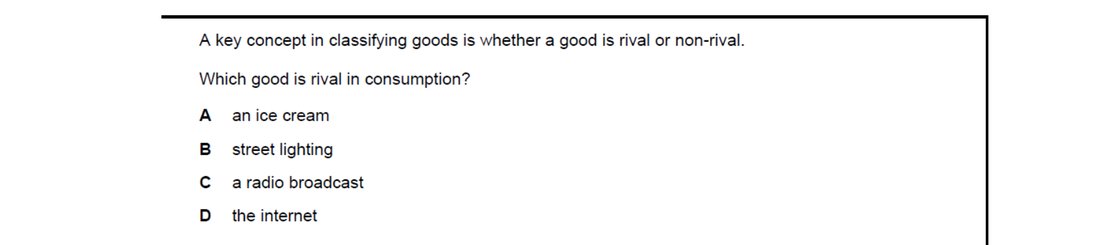
Rivalry means one person's consumption reduces what is available for others. Option A – an ice cream – is rivalrous: once eaten, no one else can have it. Street lighting, a radio broadcast and internet access (B, C, D) can be enjoyed simultaneously by many users without diminishing any individual's enjoyment, so they are non-rival.
6.2Private goods
The fundamental economic problem of scarcity arises in the context of private goods. Private goods are also called economic goods: they have an opportunity cost in terms of the resources used, they are scarce, and they command a price when bought or sold. Most of the goods people purchase regularly fall into this category — food, drinks, clothing, household items, fuel.
Private goods have two defining characteristics:
- Excludability: a price excludes anyone unwilling or unable to pay. Once one person has purchased the good, no other can simultaneously consume it.
- Rivalry: one person's consumption reduces the amount available to others. When you buy a meal or a textbook, that specific unit is no longer available to anyone else.
Free goods
Free goods are the opposite of private goods. They are not scarce, they have zero opportunity cost, they have no price, and in principle no factors of production are needed to provide them. Examples are not easy to find in modern economies, but rainwater in a river, wild fruit and berries, or air at sea level are sometimes cited. The category is small but conceptually important — most goods that surround us are economic, not free.
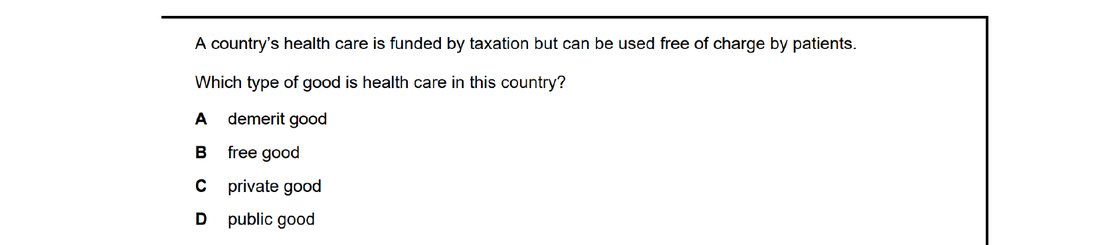
A private good is rival (one patient's bed is unavailable to another) and excludable in principle. State-funded health care that is free at the point of use remains a private good in technical classification — what changes is the funding mechanism, not the rival/excludable nature. Option C – private good – is therefore correct. It is not a pure public good because consumption is still rival.
6.3Public goods
A public good has two defining characteristics: it must be non-excludable, and it must be non-rival.
- Non-excludable: once the good has been provided for one consumer, it is impossible to stop anyone else from also benefiting.
- Non-rival: as more consumers benefit, the benefit available to those already consuming does not fall.
Examples include fire protection, the police force, national security, street lighting, traffic lights, and flood-control infrastructure. Once a flood barrier exists, everyone in the protected area benefits, and one person's benefit does not reduce anyone else's.
Quasi-public goods
Goods that are clearly non-excludable and non-rival are sometimes called pure public goods. Many real-world goods, though, only partially satisfy the two properties. These are quasi-public goods. A toll road is the classic example: it is non-rival (one driver's use does not exclude another's, up to capacity) but excludable (drivers without the toll cannot enter). A public beach is another: open to all, so non-excludable; but as the beach becomes crowded, one user's enjoyment can reduce another's, so it is not fully non-rival.
The problem caused by public goods
The serious problem public goods pose in a free market is that the market may not provide them at all. Consumers may want the good, but the market lacks a way to guarantee that profit-seeking firms will supply it. The reason is the free rider problem: because the good is non-excludable, anyone can consume it without paying. A private firm building, say, a flood barrier could not collect payment from all those who benefit. With no way to recover costs, no firm will build it.
The same logic applies to fire prevention, national defence, and non-toll roads. Without state provision (funded by taxation), public goods would be under-supplied. The free-rider problem means scarce resources are not directed to producing goods that would benefit society — markets register demand only when consumers can be made to pay, and public goods break that link.

Non-rivalry means one person consuming the good does not reduce the quantity available to others. Option B states exactly this. Option A describes non-excludability, option C describes the information-failure rationale for merit goods, and option D is about non-scarcity (free goods), so they describe different properties rather than non-rivalry.
6.4Merit goods, demerit goods and information failure
A merit good is a good thought to be desirable that the free market under-provides. Vaccination against a contagious disease is a classic example: the person vaccinated benefits directly, but so do others, who can no longer catch the disease from the vaccinated person. Markets undervalue the wider benefit.
A demerit good is the mirror image: a good thought to be undesirable that the free market over-provides. Excessive consumption of high-sugar, low-nutrient food is the textbook example; tobacco and alcohol are others. Markets undervalue the costs to the individual consumer and to others.
Governments typically provide merit goods (or subsidise them, or require their consumption) to counter under-consumption, and constrain demerit goods (through taxes, regulation, advertising bans, or outright prohibition) to counter over-consumption.
Information failure and underconsumption of merit goods
Why does the market under-provide merit goods? The central reason is information failure — consumers do not recognise how good or bad a particular product is for them. Either the information is unavailable, or it is available but not understood, or it is drowned out by other signals.
Specific situations in which information failure arises include: consumers being unaware of the benefits or harms of a product; persuasive advertising pushing consumption beyond what is in the consumer's best interests; misleading or inaccurate product packaging; and asymmetric information, where the producer knows more about a product than the consumer can. In principle, the rising volume of information available online should help consumers make better decisions; in practice the gap between information available and information understood remains substantial.
Low income and underconsumption of merit goods
Information failure is not the only cause of under-consumption. Low income matters too. Consumers may understand the benefits of education or healthcare perfectly well and still be unable to afford them. Both education and healthcare illustrate this clearly:
- Education and training produce private benefits (better skills, higher earnings, better employment prospects) and wider economic benefits (a more productive workforce that supports growth and competitiveness). Yet at the point of consumption, education has a cost that low-income families may not be able to meet.
- A healthy population benefits both individuals and the economy. Where access to doctors, hospitals and medicines requires payment, under-consumption is concentrated among low-income households. Most governments accept a moral case for providing a minimum level of healthcare regardless of income.
Overconsumption of demerit goods
Symmetrically, consumers may be unaware of — or indifferent to — the harms of demerit goods. Junk food is low in cost, easy to find, and quick to consume; obesity (including childhood obesity) is a growing public-health problem in many economies, partly attributable to over-consumption of fast food and high-sugar drinks. Tobacco is another standard example. Governments respond with heavy indirect taxes on tobacco, restrictions on advertising, health warnings on packaging, and bans on smoking in public places. Evaluating the effectiveness of each measure separately is difficult.
Some economists challenge the merit/demerit framework, arguing that the individual — not the government — is best placed to decide what is good or bad for them. The framework rests on the assumption that government has more (and better) information than the individual, and the right to apply that information through policy. Whether that assumption is justified varies by case.
Key concept link — scarcity and choice
Governments face the fundamental economic problem when deciding how to allocate their limited funds on what seem to be unlimited demands for public goods and merit goods. Choices have to be made as not all wants can be met. Choice should seek to maximise the benefits for all and not just a few people.
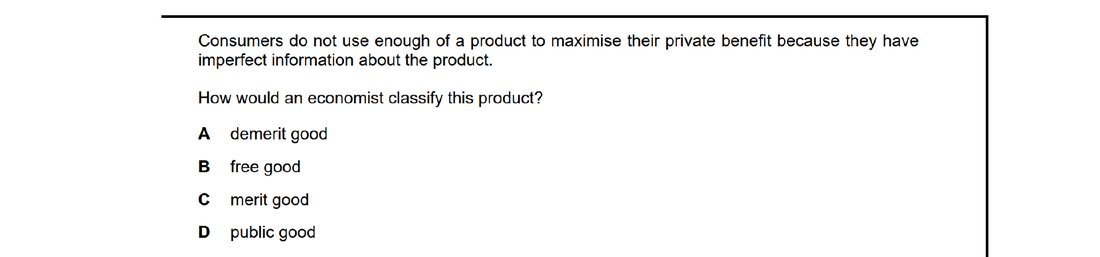
A merit good is one whose private benefit is undervalued by consumers — often because of imperfect information — so they consume less than is privately or socially optimal. Option C – merit good – fits the description exactly. A demerit good (A) is over-consumed when costs are under-appreciated, a free good (B) is unrelated to information failure, and a public good (D) is defined by non-rivalry and non-excludability, not by under-consumption.
End-of-chapter practice
Past-paper questions from CIE 9708. Pick A, B, C or D. Answers are saved on this device — press Download report (PDF) at the top to save them.
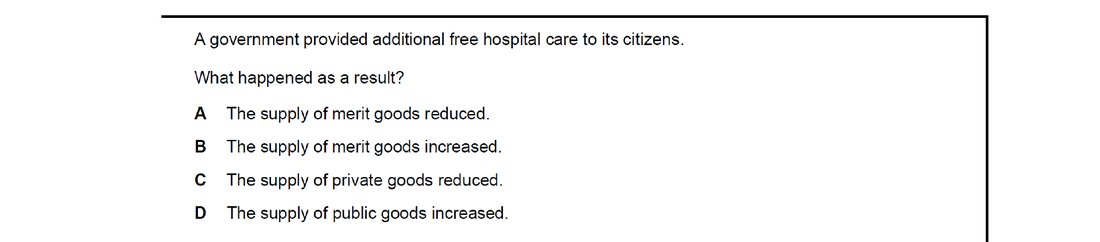
Health care is the classic merit good — under-consumed by individuals relative to social benefit. Government provision of additional free hospital care directly increases the supply of a merit good. Option B captures this. Health care is not a public good (it is rival and excludable), and the question describes more supply rather than less, ruling out A and C.
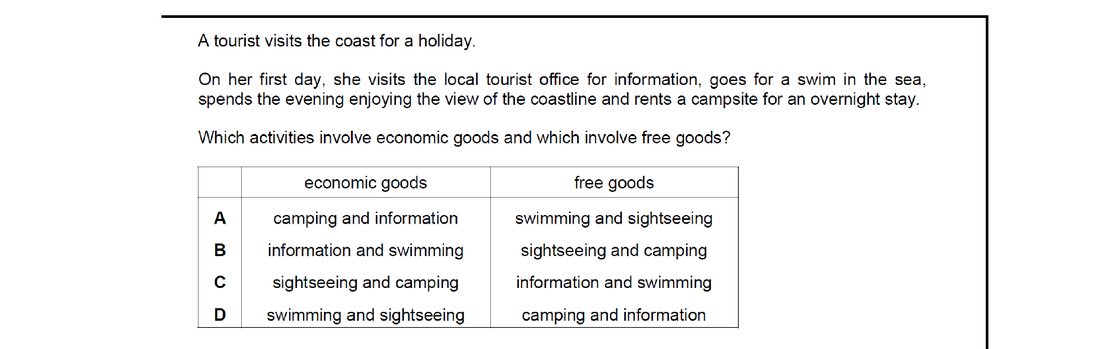
Economic goods are scarce and have an opportunity cost; free goods are unlimited at zero price. Camping (renting a site) and information (paid for indirectly through tourist-office funding/staff time) consume scarce resources, while swimming in the sea and admiring the view rely on resources that are not scarce. Option A – camping and information as economic goods, swimming and sightseeing as free goods – matches.

A public good has two defining properties: non-rivalry (one person's use does not reduce availability) and non-excludability (non-payers cannot be kept out). Option C – public goods are both non-rival and non-excludable – states this exactly. Private goods are rival and excludable (ruling out A), the private sector can supply many things besides private goods (B), and producing any good has an opportunity cost (D).
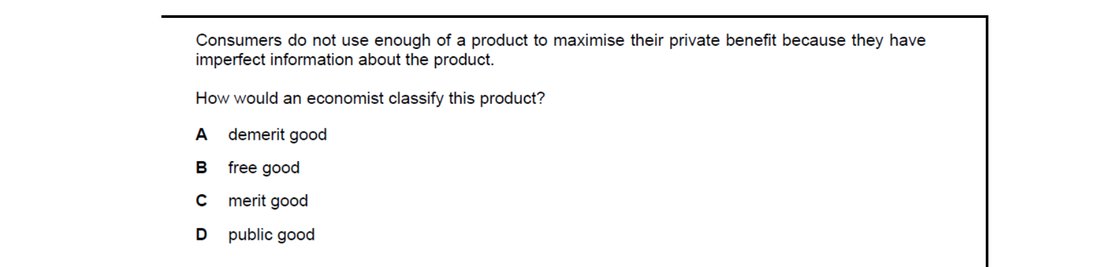
Imperfect information about benefits causes consumers to under-consume relative to the privately optimal level — the textbook definition of a merit good. Option C – merit good – matches. Demerit goods (A) involve under-appreciated costs and over-consumption, free goods (B) are not scarce, and public goods (D) are defined by non-rivalry and non-excludability rather than information failure.
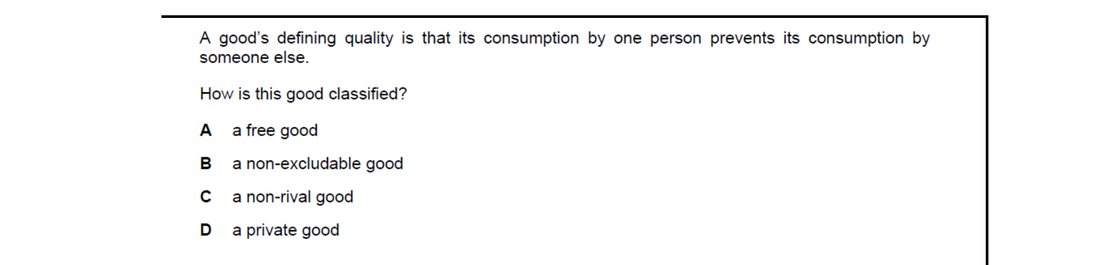
Rivalry means one person's consumption prevents another's. Option D – a private good – is the only category that is necessarily rival (and excludable). Free goods (A) are non-scarce, non-excludable (B) and non-rival (C) describe public-good properties, which by definition allow simultaneous consumption — the opposite of the stated quality.

A free good has no opportunity cost because it is not scarce — supply exceeds demand at zero price. Option D – anything that provides free utility but is not scarce – captures both criteria. The other 'free' examples (A, B, C) are economic goods whose true cost is borne by taxpayers, donors or the school; they are scarce, simply provided at no charge to the user.
Attempt the practice questions above to build your score.
Self-evaluation checklist
After studying this chapter, you should be able to:
- Understand the differences between free goods, private goods, public goods and quasi-public goods.
- Explain the difference between merit goods and demerit goods.
- Explain why a pure public good has the characteristics of non-excludability and non-rivalry.
- Analyse why merit goods and demerit goods are the result of information failure.
Want more practice? Drill this chapter's past-paper MCQs (63 questions) →